
Ghost Recon Wildlands: the complete guide to the cartel's Bolivia
There's a moment in Ghost Recon Wildlands that everyone who's played it recognizes. You're lying on top of a hill, drone in the air, tagging the guards of a cartel base one by one. The plan is perfect: four targets, four Ghosts, one synchronized shot, dead silence. Then somebody — you, your friend, the game's physics — screws up, the alarm goes off, three pickups appear on the horizon, and the tactical mission turns into an '80s action movie set in the Andes.
That's the charm of the game. Released by Ubisoft in March 2017, Wildlands took a franchise known for being rigid, slow and punishing and dropped it into one of the biggest open worlds ever built, with total freedom to solve every problem your own way. Almost ten years later, people are still playing it, squads are still forming for co-op on Discord, and here on the channel it turned into a series. This is the complete guide: where the game came from, how it works, what makes it so fun (and so messy), and why it aged better than its own sequel.
Fact sheet
- Released: March 7, 2017
- Platforms: PlayStation 4, Xbox One and PC (runs on PS5 and Xbox Series via backward compatibility)
- Developer: Ubisoft Paris, with support from other Ubisoft studios
- Genre: third-person tactical shooter, open world
- Modes: solo campaign with an AI squad, online co-op for up to 4 players, and PvP (Ghost War, added later)
Where Ghost Recon came from
The first Ghost Recon came out in 2001, made by Red Storm Entertainment — a studio co-founded by Tom Clancy himself, the author of The Hunt for Red October. The pitch was hardcore: a special-forces squad, short missions, and one shot was enough to take your soldier out. It was a planning game, not a reflex game. Anyone who played it on PC back then remembers spending more time staring at the map than shooting.
Over time, the series drifted toward action-shooter territory. Advanced Warfighter (2006) brought the "future soldier" angle with a high-tech HUD and drones; Future Soldier (2012) leaned into optical camouflage and a linear, cinematic campaign. It worked, but it left the franchise looking a lot like everything else on the market.
Wildlands was the pivot. Instead of corridors and closed missions, Ubisoft handed players an entire country and said: the cartel is out there, figure it out. The tactical DNA stayed — recon, target tagging, synced shots — but now inside a sandbox where nothing was scripted.
Wildlands' Bolivia (and the diplomatic fight)
The game is set in a near-future Bolivia dominated by the Santa Blanca cartel, a Mexican-rooted organization that turned the country into the world's biggest cocaine producer. The government is bought, the police are bought, and the Unidad military force does the dirty work whenever the cartel doesn't want to get its hands dirty.
The map is the real star. There are 21 provinces with wildly different biomes: white salt flats that look like another planet, wet jungle, farming valleys, snowy mountains, adobe villages and mining towns. At the time, it was one of the biggest open worlds Ubisoft had ever built, and you can cross the whole thing by car, motorcycle, plane, helicopter or on foot — if you have the patience.
That setting produced a rare event in gaming history: a diplomatic incident. Weeks before launch, Bolivia's interior minister, Carlos Romero, filed a formal complaint with the French embassy in La Paz — Ubisoft is French — saying the country was being portrayed as a narco-state and that Bolivia reserved the right to take legal action. Ubisoft responded that the game is fiction and that it chose the country for its "magnificent landscapes and rich culture." The game shipped on schedule, and the controversy became just another footnote in the title's history.
The cartel as an org chart
Wildlands' progression structure is one of the game's coolest ideas. The Santa Blanca cartel is presented as an actual org chart, with supreme boss El Sueño at the top and four divisions underneath:
- Security — the cartel's armed muscle, hitmen and military commanders
- Smuggling — transport routes, clandestine airstrips, logistics
- Production — the coca plantations and labs
- Influence — the political side: propaganda, image laundering, contacts inside the government
Every province has a local boss tied to one of these divisions. You gather intel, interrogate lieutenants, take down underbosses, and the org chart fills in with crossed-out photos until you reach the top. There's no mandatory order: you can hit Production first and leave Security for last, or jump from one end of the map to the other on a whim. It's the classic "Ubisoft formula" for open worlds, but with a narrative thread that gives the checklist some meaning.
The Kataris 26 and rebel resources
You're not alone against the cartel. The local resistance, the Kataris 26, is your ally in the country. The campaign's very first mission, in fact, is rescuing Amaru, the movement's historic leader — and that's exactly the mission that opened our series on the channel.
Across the map, you find supplies (fuel, medicine, communications and food) and complete side missions for the rebels. Those resources, combined with your Ghost's skills, unlock field support: rebel vehicles delivered wherever you are, mortar strikes, distractions, fighter reinforcements, and recon sweeps. It's a simple system, but it does a lot to make the game feel like a guerrilla war rather than just clearing icons off a map.
How it plays: recon first, shooting second
Wildlands' basic loop works like this:
- Get close without being seen. Roads are dangerous: there are Unidad checkpoints and cartel patrols.
- Scout the area. Drone and binoculars tag enemies, alarms, generators and the mission target.
- Pick an approach. Long-range sniping, night infiltration, a frontal assault, a rebel mortar distraction — or all of it at once when things go sideways.
- Execute and get out. If the alarm goes off, reinforcements arrive by pickup and helicopter. Sometimes the best tactic is simply running for it.
The day/night cycle and weather change the mission: at night the guards' vision drops and night-vision goggles become your best friend; in the rain, footsteps are better disguised. It's the kind of system that rewards planning — and forgives not planning, because the game never forces you to restart just for getting spotted.
Car physics (a chapter of its own)
We need to talk about the driving. Wildlands' cars are famous for a… peculiar behavior. They flip on slopes, skid like the road is made of soap, and fly off bumps that shouldn't launch anything. The helicopters are even worse until you get the hang of them. Some players consider this a flaw; we consider it content. Episode #01 of the series is basically a documentary about the worst driver in Bolivia — and the guy who's already sunk hours into Top Gear on the Super Nintendo should really drive better than this.
If you want the details on that first mission, we wrote about it in the post the stealth run that turned into chaos in Bolivia.
Playing solo: the AI squad
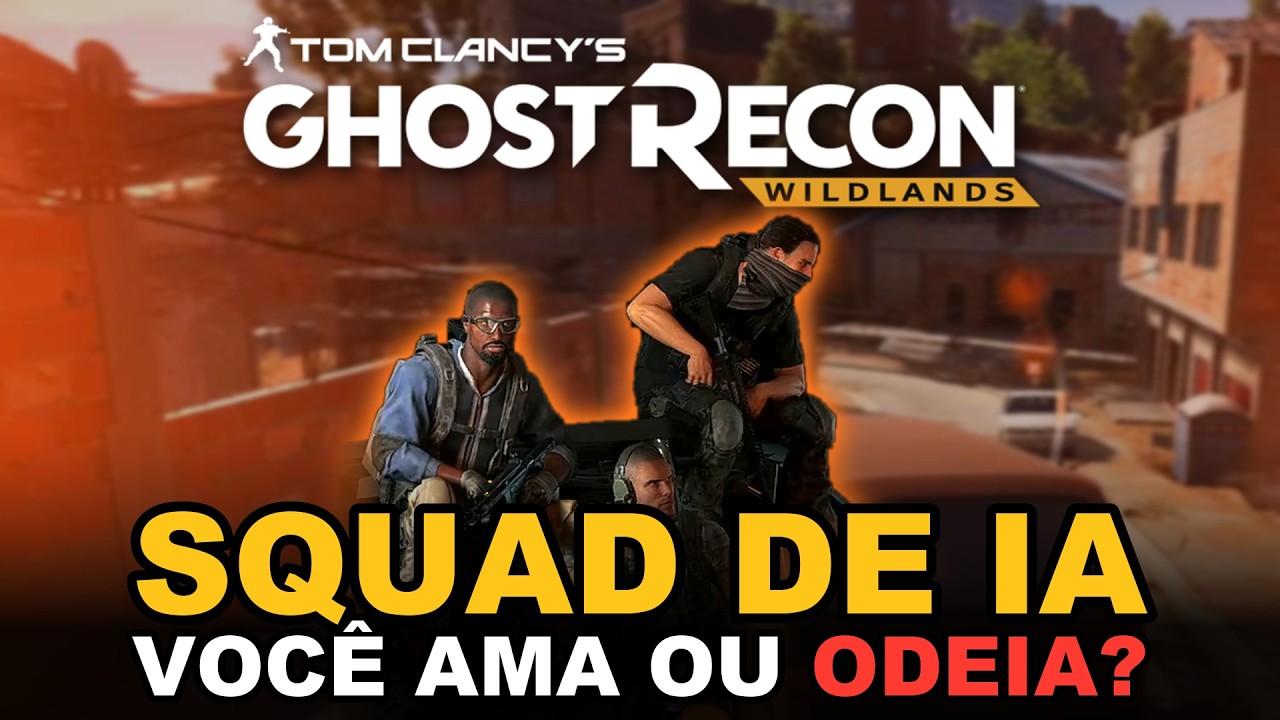
A lot of people think Wildlands only works in co-op. That's not true. In solo mode, three AI-controlled Ghosts accompany you the whole time: Holt, Midas and Weaver, each with a personality of their own. The banter between them during car rides is part of the charm — and, truth be told, they're pretty good shots.
Squad control runs through a command wheel: order them to advance, regroup, hold position, or open fire. The most powerful tool is the synchronized shot: you tag targets, each AI Ghost gets assigned one, and the moment you give the command (or fire), they all drop at the same time. It's the most "Tom Clancy" thing in the whole game, and it gets better and better as you invest in squad skills, which extend the synced shot and improve your teammates' performance.
One thing the game doesn't spell out clearly: the AI is so efficient that, if you let it, it will basically finish the game for you. You can sit back and watch the squad clear out an entire base on its own. We made a tutorial showing exactly that — how to give orders, how to tag targets for the synced shot, and which squad skills are worth leveling first:
Practical tip: the drone is your best early investment. More range, more battery, and the ability to tag targets straight from the drone turn the synced shot into a base-clearing tool without a single cartel member ever figuring out where the shot came from.
Co-op: where Wildlands becomes a different game
With friends, Wildlands moves into a whole different category. Co-op for up to four players swaps the AI Ghosts for actual people — and actual people are a lot less reliable than the AI. The synced shot turns into a "three, two, one… who fired early?" The helicopter becomes an accidental weapon of mass destruction. And the stealthy plan lasts exactly until someone decides they're done waiting.
It's a direct descendant of those Counter-Strike nights at the LAN café: the fun isn't only in the game itself, but in the chaos of communication between friends. Wildlands just took that and dropped it onto a 21-province map.
In episode #02 of the series, I brought in Gabriel — who introduced himself as "the greatest killer of all time." The final tally: a wall that refused to fall, a helicopter run that went wrong five times, a bird taken out by gunfire, more than five civilians down, and a crash at the end that we prefer to believe was the game dying of embarrassment:
In #03, the setup changed: one friend in co-op, but me playing as a one-man squad. There was time to become a sniper at 222 meters, for the mission to bug out, for the kill counter to keep climbing — and yes, even a chicken got caught up in it. My friend, meanwhile, blew up the helicopter. Which leaves the episode's serious question: does blowing up the helicopter count as helping?
Civilians: the detail that punishes chaos
If there's one rule Wildlands takes seriously, it's this: killing a civilian has consequences. Depending on the situation, the game can end the mission on the spot and send you back to the last checkpoint. In co-op, with four people shooting in different directions inside a village, that becomes an endless source of arguments — and content. Just ask the civilian counter from episode #02.
Post-launch: Predator, Sam Fisher and Ghost War
Wildlands got support for a lot longer than most people realize. Among the main additions:
- Narco Road and Fallen Ghosts (2017) — the two paid Season Pass expansions. The first trades tactical warfare for infiltrating the drug-trafficking world, with souped-up vehicles and a reality-show vibe; the second traps the Ghosts after their helicopter goes down, facing a better-equipped enemy force.
- Ghost War (October 2017) — the free 4v4 PvP mode, with classes and a full focus on tactics. It kept a loyal community for years.
- Predator event (December 2017) — yes, the alien from the 1987 movie hunting Ghosts through the Bolivian jungle. One of the most unexpected and memorable crossovers of the generation.
- Operation Oracle (2018) — a special mission featuring Sam Fisher, the Splinter Cell protagonist, voiced by Michael Ironside, in an appearance fans had been asking for for years.
- Special Operations — a run of free updates with new modes, missions and gear that kept the game alive through its second year.
The numbers: the franchise's biggest hit
Critics were split — scores hovered around 70, with praise for the map and co-op and criticism for the shallow story, repetitive missions and vehicle physics. The public, though, disagreed loudly:
- Wildlands was the best-selling game of March 2017 in both the United States and the United Kingdom — in a month that also had Zelda: Breath of the Wild and Horizon Zero Dawn.
- It finished 2017 as the 7th best-selling game of the year at US retail, according to NPD.
- It had the second-best launch in the history of the Tom Clancy brand, behind only The Division.
- It passed 15 million players over its lifetime, and sits among the Ubisoft titles of that generation to cross 10 million units sold.
It's the classic case of a game critics called "fine" and the public turned into a phenomenon — largely thanks to co-op, the kind of experience that never shows up in a review based on 10 hours played solo.
Breakpoint and the lesson Ubisoft learned too late
October 2019 brought the sequel, Ghost Recon Breakpoint. Instead of Bolivia, a fictional Pacific island; instead of the cartel, a military tech company taken over by rebel ex-Ghosts, with Jon Bernthal playing the villain, Cole D. Walker. On paper, promising ideas. In practice, the launch was one of Ubisoft's worst moments of the generation.
The game shipped full of bugs, with a looter-shooter-style gear-level system (which clashed with the tactical premise), aggressive microtransactions and — the mortal sin — no AI companions. Anyone playing solo was literally alone. The audience that had loved Wildlands' squad complained so much that, through 2020, Ubisoft rolled out an "Immersive" mode that let players turn off the gear-level system, followed by the long-requested AI companions.
Breakpoint got a lot better after that, but the first impression stuck. And that stumble helped cement Wildlands as the high point of the modern franchise: the game that understood Ghost Recon's real appeal is the squad — AI or friends — and the freedom to build a plan (and watch it fall apart).
Is Ghost Recon Wildlands worth playing in 2026?
Yes, for a few solid reasons:
- Price: the game is constantly on sale on digital storefronts, and the edition with the expansions usually goes for a fraction of the original price.
- Visuals: the map still looks great. The salt flats at sunset hold up well against much newer games, and it runs smoothly on current hardware.
- Solo works: with the AI squad, you can finish the entire campaign without depending on anyone.
- Co-op is irreplaceable: few games deliver the chaos of four friends trying to execute a stealth plan on a map this size.
What aged poorly: the story is forgettable, the side missions repeat a lot after a few provinces, and the vehicle physics… well, you already know. But none of that takes away from the core fun.
Quick tips for newcomers
- Level up the drone first. Range and target-tagging are worth more than any weapon early on.
- Use the synced shot without mercy. It's the strongest tool in the game in solo mode.
- Collect the rebel supplies. They unlock the best skills and field support.
- Play at night when you can. Infiltration gets a lot easier.
- Avoid main roads. Unidad checkpoints turn a 2-minute drive into a 20-minute war.
- Watch out for civilians. Especially in co-op, and especially near friends carrying grenade launchers.
- Don't trust your friend behind the helicopter's controls. Personal experience. Episode #03.
The series continues
Wildlands is the kind of game that's better told than summarized — because every mission produces a different story. That's why it became a series on Insert Coin Brasil: commentary gameplay, no chaos left on the cutting-room floor, with the (failed) goal of one day pulling off an entire mission in full stealth. So far we have three episodes and one tutorial, and episode #04 and a second tutorial, about the character and skills, are on the way.
If you're also on the team that starts with the suppressor and ends up with the rocket launcher, or the purist team that never fires outside the plan, tell us in the video comments what your approach is. And subscribe to the channel to follow the rest of the war against the cartel: El Sueño is still standing — and Bolivia hasn't seen its worst driver give up yet.
Read next

Ghost Recon Wildlands: the stealth run that turned into chaos in Bolivia
First mission of Ghost Recon Wildlands: the plan was stealth, the result was chaos — wrecked cars and 31 targets down …
Did Top Gear do car tuning before NFS Underground? Yes — in 1993
Ten years before NFS Underground turned tuning into culture, Top Gear 2 was already selling engines, gearboxes and nitro …

Fast travel: why you want to skip life's boring parts
In games, fast travel is comfort — skip the journey, appear at the destination. In life, when you want to skip the …
Comments