
UNIVAC I at 75: the computer that called an election and was silenced
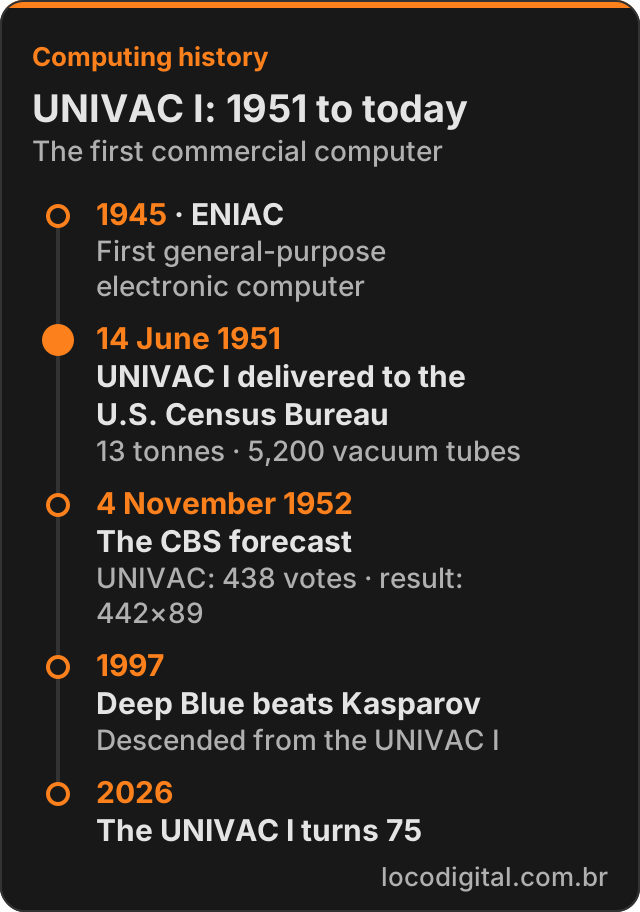
Philadelphia, 14 June 1951. An object weighing 13 tonnes, with 5,200 vacuum tubes and 350 square feet of floor space, is formally handed over to the U.S. Census Bureau. The technicians call it the UNIVAC I — UNIVersal Automatic Computer. It was the first commercially produced computer in history. Today it turns 75.
That date tends to get swallowed by the noise of smartphone launches and AI announcements. It shouldn't. The UNIVAC I is ground zero for everything that followed — the direct lineage that reaches the processor rendering these words right now.
ENIAC begat UNIVAC
J. Presper Eckert and John Mauchly had already built ENIAC in 1945 — the world's first general-purpose electronic computer, created so the US Army could calculate ballistics tables. But ENIAC was a one-off, a laboratory machine, funded by the government. Eckert and Mauchly wanted something different: a computer that could be sold, configured for different tasks, and operated by commercial organisations.
They founded the Eckert-Mauchly Computer Corporation in 1946. The plan was noble; the financial execution, disastrous. In 1950 the company was acquired by Remington Rand — a maker of typewriters and office equipment. It was under that new roof that the UNIVAC I was finished and delivered.
Between 1951 and 1957, 46 units were sold. Customers included the Census Bureau itself, GE, Prudential Insurance and the US Air Force. Each unit cost roughly $1 million at the time — something like $12 million in 2026 money.
What the UNIVAC I was, technically
Comparing the UNIVAC I with modern hardware is almost absurd, but the exercise reveals the scale of the distance computing has travelled:
- Weight: 29,000 pounds (~13 tonnes)
- Valves: 5,200 vacuum tubes
- Speed: ~1,905 operations per second (a 2.25 MHz clock)
- Power draw: 125 kW — enough for a small village
- Memory: mercury delay lines, 1,000 words of 12 digits
- Storage: magnetic tape instead of punched cards — an Eckert and Mauchly innovation that dramatically eased the handling of large volumes of data
The UNIVAC I did not operate in pure binary — it worked directly with encoded decimal digits, which made it more intuitive for business applications and government statistics. It was "the fastest business machine ever built", according to the documents of the period.
The night CBS hid a correct forecast
The UNIVAC I's most famous moment was not the delivery to the Census Bureau. It was the night of 4 November 1952.
CBS hired the UNIVAC (a unit belonging to the Atomic Energy Commission, borrowed for the night) to predict live the result of the US presidential election between Dwight Eisenhower and Adlai Stevenson. The machine stayed in Philadelphia — too big and too delicate to move. In New York, Walter Cronkite presented the programme with a dummy terminal connected by teletype to the real machine.
With only 5.5% of the votes counted, the UNIVAC calculated: an Eisenhower victory at odds of 100 to 1, with 438 Electoral College votes. The problem? The traditional polls (Gallup among them) predicted a tight race. The gap was simply too glaring.
The CBS technicians assumed the machine was faulty. They manually altered the "national tendency factor" from 40% to 4% and broadcast a watered-down forecast of 268×263 — feigning a close race where the machine saw a landslide.
Eisenhower won 442×89 in the Electoral College — almost exactly what the UNIVAC had calculated hours earlier. After the result came in, CBS admitted on air what it had done. The commentator's line that night became famous: "UNIVAC was honest with us. We were not honest with UNIVAC."
The algorithm had been written by the mathematician Grace Hopper — the same person who invented the concept of the compiler and popularised the term "bug" — in partnership with the statistician Max Woodbury. It still works today, in practice: comparing partial returns with electoral history to estimate final results.
Why 1951 is the milestone, not 1945
ENIAC is frequently cited as the "first computer". It is the first general-purpose electronic computer — and that is correct. But it was a one-off, government-funded, programmed by physically reconfiguring cables and switches. It did not exist as a product.
The UNIVAC I is a different kind of milestone: the moment computing stopped being a research project and became commercial infrastructure. The Census Bureau did not want to study the machine — it wanted to use the machine to process data from the 1950 census, which involved more than 150 million records. That is real use, at scale, on a real problem.
The lineage is direct: UNIVAC → IBM System/360 → DEC minicomputers → the PC → the cloud server. When you read about Deep Blue beating Kasparov in 1997, you are reading about a machine descended, in an unbroken line, from the UNIVAC I.
What the UNIVAC I teaches about technology today
Two lessons remain relevant 75 years later.
The first is about trust in automated systems. CBS knew the algorithm was mathematically consistent, that it had data and a model; it ignored the result because it did not fit human expectation. It is the same reflex we see today when security teams receive SIEM alerts that "look overblown" and dismiss them — until the incident confirms itself hours later.
The second is about hardware versus fundamentals. The UNIVAC I was obsolete in under a decade. But the theory underpinning the work of Eckert, Mauchly and Hopper — and which Claude Shannon had formalised as information theory — survived and still defines how digital systems work. Hardware always ages; an architecture of principles lasts.
Curiously, both the UNIVAC and Deep Blue ran into the same problem: the humans around them distrusted the result before accepting that the machine was right. In 1952 it took a night. In 1997 it took a few moves. The resistance got shorter — but it did not disappear.
Where the UNIVAC I is today
No complete UNIVAC I has survived. Parts of the original console are at the Smithsonian National Museum of American History in Washington. The Computer History Museum in Mountain View, California, preserves documentation and components. The Census Bureau maintains a detailed historical archive with photographs and original reports from the 1951 delivery.
Seventy-five years on, the legacy is not nostalgic — it is structural. Every time a business process runs on a server, every time a statistical forecast informs a decision, the UNIVAC I is in the genealogy. Sometimes it is worth stopping to trace where things came from — especially when the present feels so new that we forget somebody had to invent the beginning.
If you work in infrastructure or technology and had never stopped to think about this history, it is worth exploring the collection at the Computer History Museum — they hold decades of primary documentation that never makes it into Wikipedia summaries.
Read next

Deep Blue 1997: the day the machine beat the world champion
On 11 May 1997, IBM's Deep Blue beat Kasparov at chess. Twenty-nine years on, what did that match really prove about …
Claude Shannon at 110: the man who invented the bit
Claude Shannon was born on 30 April 1916. 110 years on, the bit he invented is still the foundation of absolutely …
10 years without the jack: how the iPhone 7 killed it in 2016
On 7 September 2016, Phil Schiller said 'courage' and the iPhone 7 arrived with no headphone jack. Ten years on, …
Comments